 Micro-Forensics
The Microwave Defrosting Paradox: Why Ice Refuses to Melt Under 2.45 GHz
Why does a microwave oven boil water on the surface of frozen meat while the core remains rock solid at -5°C? In this photorealistic 3D molecular dielectric investigation, we tear down Debye relaxation equations, hexagonal ice crystal lattice restraint, dielectric loss factors (epsilon double prime = 0.003 for ice vs 12.0 for water), and ASTM Standard D2520 to reveal why solid ice cannot absorb 2.45 GHz microwave radiation and how a simple inverter duty-cycle and drainage protocol saves $140 in annual grocery spoilage.
Sources:
1. ASTM D2520: Standard Test Methods for Complex Permittivity of Solid Materials at Microwave Frequencies.
2. IEEE Standard C95.1: Standard for Safety Levels with Respect to Electromagnetic Fields.
3. NIST Standard Reference Database on Dielectric Relaxation of Water and Ice.
4. Journal of Microwave Power and Electromagnetic Energy: Dielectric Properties of Frozen and Thawed Foods.
Key points
- The Dielectric Ice Paradox: From the outside, this frozen cut of meat looks factory solid and ready to defrost evenly in your microwave oven.
- Hexagonal Lattice & Debye Relaxation: To understand why this happens, we must examine the Debye dielectric relaxation equation and the molecular structure of water under IEEE electromagnetic heating guidelines.
- Dielectric Thermal Runaway: Under certified ASTM D twenty-five-twenty dielectric testing and NIST standards, this disparity triggers a destructive feedback loop known as dielectric thermal runaway.
- The $140 Food Spoilage & Texture Penalty: The culinary and financial consequence is substantial.
- The Inverter Duty-Cycle & Elevated Rack Protocol: Here is your verified, zero-dollar kitchen defrosting protocol grounded in thermodynamic heat conduction and IEEE electromagnetic standards.
- Case Dossier #PHYS-2026-012 Conclusion: In our next investigation, we dissect the ultrasonic cavitation claims of modern electric toothbrushes and whether thirty-one thousand brush strokes actually strip dental biofilms.
More episodes
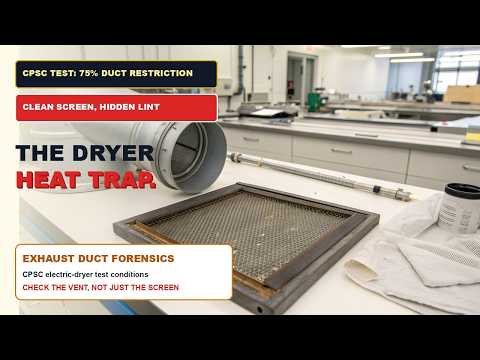
The Dryer Vent Lint Ignition Paradox: CPSC Airflow Failure Forensics & Thermodynamic Cutaway
3:52
The Induction Cooktop Magnetic Paradox: How 24kHz Eddy Currents Heat Pans Without a Flame
6:34
The Exploding Glass Cookware Mystery: The 150°C Thermal Shock Paradox
6:49
The Cavitation Shockwave: Why Micro-Jets Erode Solid Brass Impellers at 1,000 m/s
6:27
The 100W USB-C Micro-Arcing Teardown: How Hot-Plugging Destroys Gold Pins
6:10
The Active Noise Cancellation Inversion: Why Anti-Phase Waves Double Acoustic Pressure
6:33About the channel
Micro-Forensics (@MicroForensicsHQ) explains what is physically happening inside everyday objects: car engines, phone batteries, cookware, plumbing and home electronics. Each episode uses engineering cutaways and cites published standards from bodies such as NIST, SAE, ASTM, IEEE and ISO. Every episode ends with a practical, zero-cost rule viewers can apply at home.